Best Air Purifiers for a Bedroom With Cat Allergies
Choosing an air purifier for a bedroom? Size it by CADR, check noise levels, and set it up so you sleep better around cat allergens.
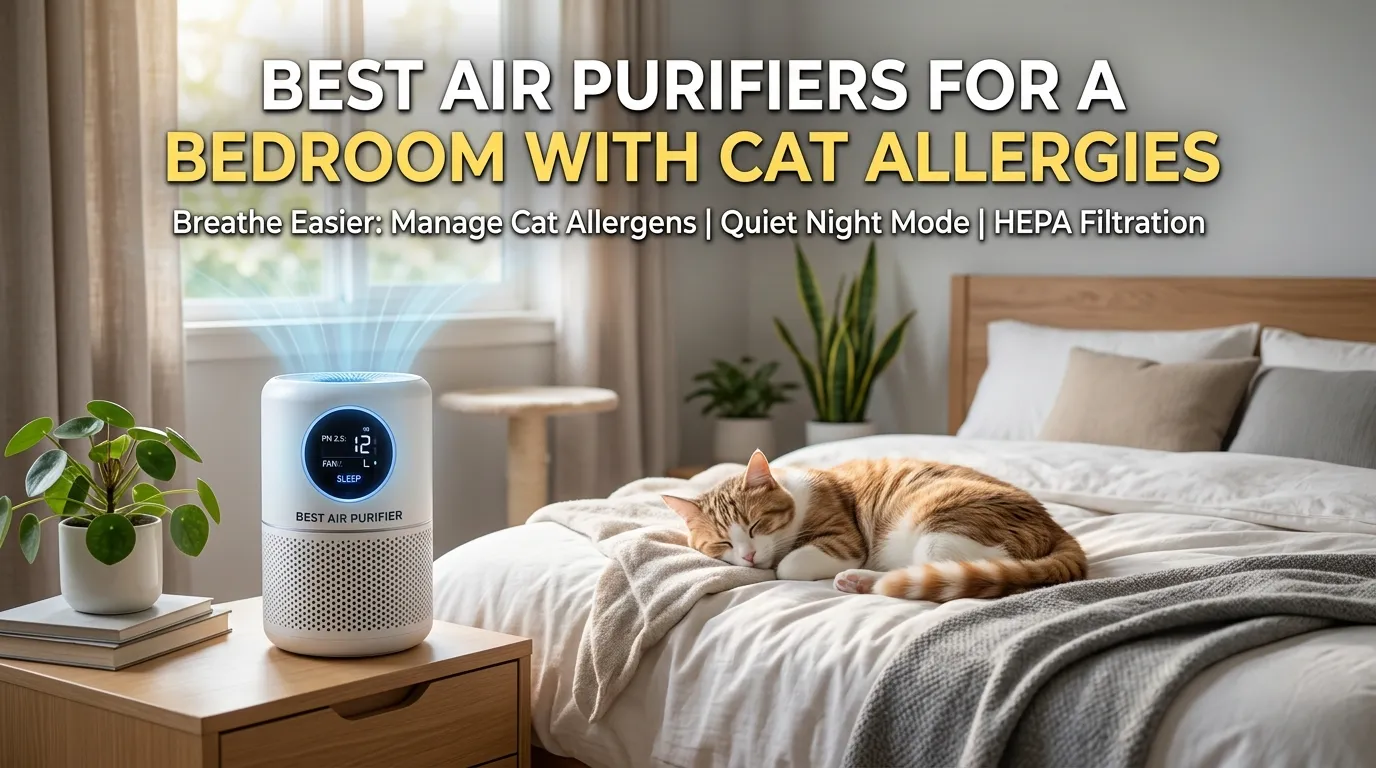
If you are looking for the best air purifier for bedroom cat allergies, the direct answer is that success comes down to sizing the unit correctly by CADR for your exact room dimensions, choosing an ultra-quiet fan under 30 dBA with blackout display controls, and running it continuously. Unlike whole-home units where raw fan power dominates, a bedroom purifier must deliver medical-grade True HEPA filtration without disrupting your sleep with motor whine or glaring LED lights.
While our general guide to the best air purifiers for cat allergies focuses on high-capacity units designed for spacious open-concept living rooms, the bedroom requires a fundamentally different engineering balance. You spend approximately one-third of your life sleeping. If microscopic feline allergens trigger nighttime congestion, coughing, or asthma, waking up exhausted ruins your daily quality of life.
In this guide, we break down how to size a bedroom air purifier using industry CADR metrics, what acoustic and lighting features ensure sound sleep, essential safety certifications, and how to position your unit to create an allergen-free sleep sanctuary.
Bedroom Sizing: CADR vs. Floor Area
Selecting an air purifier based solely on generic manufacturer room claims (such as "cleans up to 500 sq ft") often leads to poor nighttime filtration. Manufacturers frequently calculate those maximum coverage claims based on only one or two air changes per hour (ACH) running on maximum speed—a speed far too loud to tolerate while sleeping.
To effectively clear feline allergens while operating on whisper-quiet low speeds, you must size your unit using the Clean Air Delivery Rate (CADR) developed by the Association of Home Appliance Manufacturers (AHAM).
+--------------------------------------------------------------------------+
|                       AHAM 2/3 RULE OF THUMB                             |
|                                                                          |
|   CADR (Smoke / Fine Particle)  >=  2/3 * Room Floor Area (sq ft)       |
|                                                                          |
|   Example: 150 sq ft Bedroom   -->   Minimum CADR: 100 CFM              |
|   Example: 240 sq ft Bedroom   -->   Minimum CADR: 160 CFM              |
|   Example: 300 sq ft Master    -->   Minimum CADR: 200 CFM              |
+--------------------------------------------------------------------------+
The 2/3 Sizing Rule of Thumb
The standard AHAM guideline recommends that an air purifier's smoke CADR rating should equal at least two-thirds of the room's total floor area in square feet (assuming standard 8-foot ceilings).
- Why Smoke/Pollen CADR Matters: Airborne cat dander flakes carrying the Fel d 1 protein measure between 2 and 10 microns, with fine particles under 5 microns remaining airborne indefinitely. Smoke and fine dust CADR benchmarks accurately reflect a filter's ability to pull these buoyant microscopic flakes out of circulation.
- The "Oversizing for Sleep" Strategy: To sleep comfortably, you will run your purifier on its lowest setting or dedicated "Sleep Mode," which operates at roughly 25% to 40% of the unit's maximum airflow. By choosing an air purifier rated for a room 30% to 50% larger than your actual bedroom, its quiet low setting will still deliver the 4 to 5 air changes per hour (ACH) needed to keep dander concentrations near zero overnight.
Acoustics, Sleep Mode, and Display Controls
An air purifier that keeps you awake with high-pitched motor hum or luminous display lights does more harm to your health than good. When evaluating units for sleep spaces, consider three non-negotiable acoustic and user-interface factors based on manufacturer specs and published ratings:
1. Decibel Thresholds for Sleep
- Under 25 dBA (Ideal): Nearly imperceptible. Comparable to rustling leaves or gentle breathing; ideal for light sleepers.
- 25 to 30 dBA (Acceptable): Sounds like a soft, steady white noise hum. Most adults sleep comfortably with sound in this range.
- Above 35 to 40 dBA (Distracting): Comparable to a humming refrigerator or quiet conversation; can interfere with slow-wave deep sleep.
2. White Noise Quality (Pink vs. Whine)
Not all 25-decibel sounds are equal. High-quality brushless DC motors paired with aerodynamic fan blades produce a smooth, broadband "pink noise" that masks outside street traffic. Budget AC motors often produce an irritating 60 Hz electrical hum or high-pitched bearing whine that becomes agonizing in a quiet bedroom.
3. True Display Blackout
Many modern appliances feature vibrant blue or white LED control panels that illuminate an entire dark room. Exposure to blue LED light suppresses human melatonin secretion, delaying sleep onset. Look for units featuring a dedicated Sleep Mode or Display Off button that completely extinguishes all indicator lights while maintaining continuous fan operation.
True HEPA Filtration, Ozone Avoidance, and CARB Listing
Because you breathe thousands of liters of air overnight in an enclosed space, filter mechanics and air safety standards are paramount:
+--------------------------------------------------------------------------+
|                  AIR PURIFIER FILTERING & SAFETY STANDARDS               |
|                                                                          |
|  [True HEPA Standard]  Traps >= 99.97% of particles down to 0.3 microns   |
|  [Mechanical Only]     Captures dander physically without chemical byproducts|
|  [Zero Ozone / Ion]    Avoid electrostatic ionizers; can trigger asthma   |
|  [CARB Certified]      Verified by California Air Resources Board for safety|
+--------------------------------------------------------------------------+
- Mechanical True HEPA Baseline: A legitimate True HEPA filter captures at least 99.97% of airborne particles down to 0.3 microns. Beware of vague marketing terms like "HEPA-type," "HEPA-style," or "99% pure," which often allow sub-micron dander particles to pass straight back into your breathing space.
- Avoid Ozone Generators and Ionizers: Never purchase an ozone generator or run an active bipolar ionizer in a bedroom. Ozone is a known lung irritant that oxidizes delicate airway tissue, worsening asthma and allergic rhinitis.
- Verify CARB Compliance: Ensure any air purifier you buy is certified by the California Air Resources Board (CARB) as an electrical air-cleaning device producing zero or near-zero ozone emissions (under 0.050 ppm).
Recommended Bedroom Air Purifiers for Cat Allergies
The following air purifiers combine high-efficiency True HEPA filtration, low sleep-mode acoustics, and total light blackout controls based on manufacturer specs and published ratings.
Levoit Core 300S Smart True HEPA Air Purifier — Best for Small to Medium Bedrooms
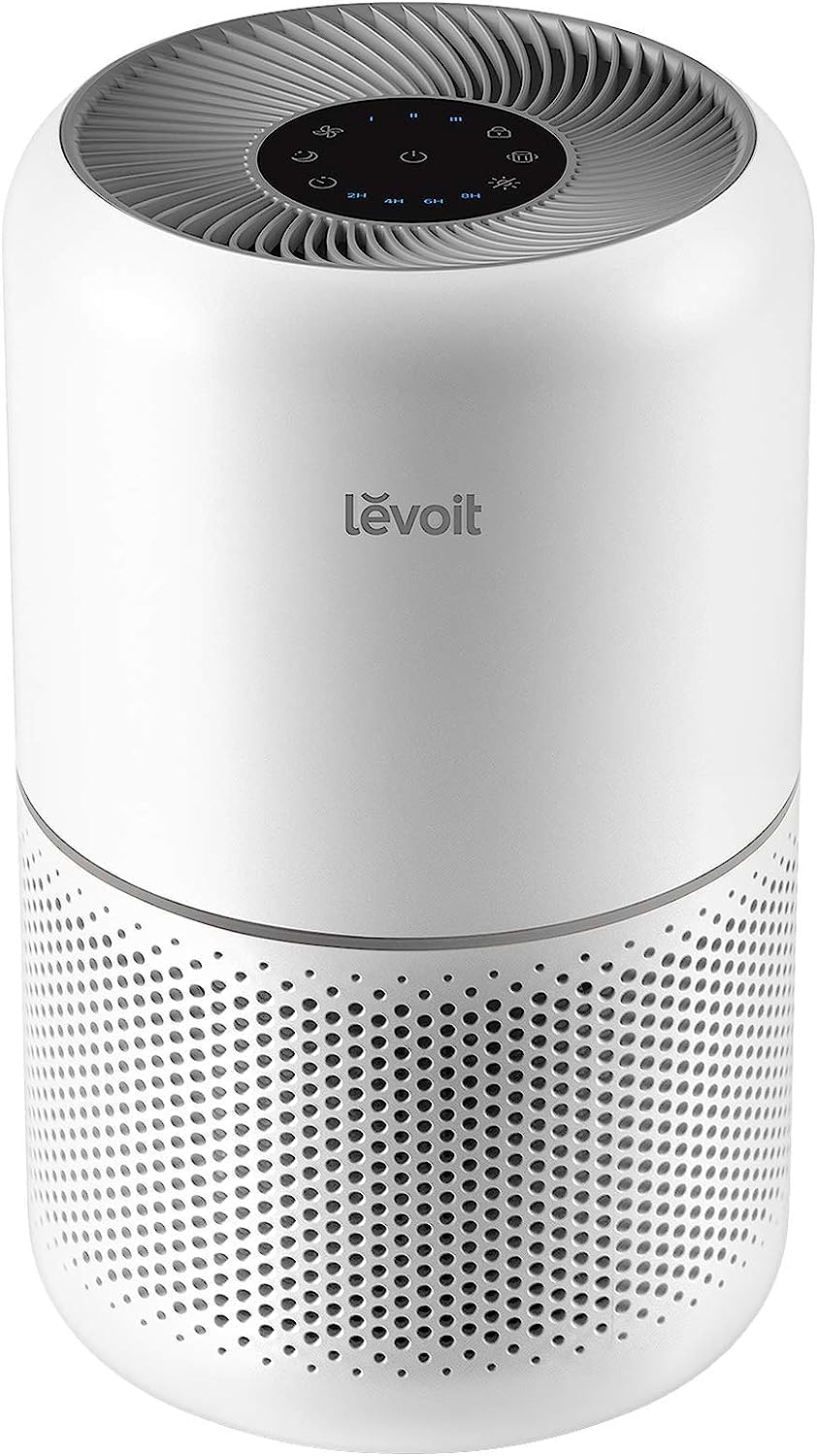
The Levoit Core 300S is an ideal compact choice for bedroom allergy management, delivering certified H13 True HEPA filtration in a quiet, nightstand-friendly form factor.
Key Highlights
- Sleep-Friendly Acoustics: Operates as quietly as 24 dBA on Sleep Mode, creating a soft, non-disruptive white noise baseline.
- Complete Display Blackout: Features a dedicated display-off button so indicator lights will not illuminate a dark bedroom.
- VortexAir 360° Intake: Draws in buoyant cat dander and hair from all angles across rooms up to 219 sq. ft.
- Smart Scheduling: Allows you to run higher fan speeds during the day and drop automatically to whisper-quiet mode before bedtime.
Pros
- Extremely quiet sleep operation with complete light shutoff.
- Compact footprint fits easily on nightstands or dressers.
- True HEPA filtration traps 99.97% of airborne dander particles down to 0.3 microns.
Cons
- Best suited for rooms up to ~219 sq. ft.; larger master bedrooms require a higher CADR unit.
Placement and Operating Schedule in the Bedroom
Where and how you run your bedroom air purifier directly determines how well it shields your breathing zone:
Optimal Room Placement
- Position Near the Headboard (3 to 6 Feet Away): Place the unit within a few feet of your bed so that purified, dander-free air washes across your pillow before mixing with room air.
- Maintain 360-Degree Clearance: Keep the intake grilles at least 12 to 18 inches away from walls, nightstands, and heavy drapes. Tucking an air purifier into a tight corner chokes its intake and cuts efficiency by up to 50%.
- Elevate if Needed: In bedrooms with thick carpeting, elevating the unit onto a low nightstand or table prevents it from sucking up settled floor carpet lint, keeping the HEPA filter dedicated to floating dander.
Continuous 24/7 Running Schedule
Do not turn your air purifier on 30 minutes before bedtime and expect a clean room. Microscopic cat allergens take hours to settle and are constantly re-suspended by walking across the room or opening the door.
- Run the unit on Medium or Auto during the day when you are out of the bedroom to maximize air turnover.
- Switch to Sleep Mode or Low setting at bedtime for whisper-quiet filtration through the night.
Filter Replacement and Maintenance Without Unexpected Costs
A clogged HEPA filter restricts airflow, increases motor strain, and ceases to trap microscopic dander efficiently. Keep maintenance predictable without overspending:
- Vacuum the Pre-Filter Monthly: Most True HEPA purifiers include an outer mesh or foam pre-filter. Gently vacuuming this screen once a month removes coarse pet hair and lint, extending the lifespan of the underlying HEPA filter.
- Replace the True HEPA Filter on Schedule: Under typical residential pet conditions, replace the main HEPA filter every 6 to 12 months.
- Plan for Replacement Costs: Before purchasing an air purifier, verify that replacement filters are readily available and reasonably priced. A cheap unit with expensive, hard-to-find proprietary filters often ends up neglected.
Building an Allergen-Free Bedroom Sanctuary
An air purifier is the cornerstone of nighttime respiratory defense, but it cannot fight cat allergens alone if dander is constantly tracked into your bed. To eliminate nocturnal cat allergy symptoms, combine your purifier with a strict sanctuary routine:
- Enforce a Strict No-Cats Bedroom Rule: Keep the bedroom door permanently closed 24 hours a day. Allowing your cat to nap on your bed transfers salivary Fel d 1 straight into your pillowcases and duvet.
- Encase Pillows and Mattresses: Use zippered allergen-barrier encasements to seal existing dander away from your airways. Compare top encasements in our guide on allergen-proof bedding covers for cat owners.
- High-Heat Bedding Laundry: Wash bed sheets and pillowcases weekly in water heated to at least 130°F (54°C) to denature secretoglobin proteins.
- Implement Broader Environmental Steps: Explore our complete household protocol in our guide on how to reduce cat allergens at home.
Key Takeaways
- Size by CADR, Not Square Footage: Use the AHAM 2/3 rule to ensure the unit delivers at least 4 to 5 air changes per hour while running on its quietest setting.
- Prioritize Noise and Light Controls: Choose purifiers operating under 30 dBA on low with a dedicated display-off function to protect sleep quality.
- Demand Certified True HEPA: Only mechanical True HEPA filters (capturing ≥99.97% down to 0.3 microns) reliably remove microscopic Fel d 1 dander without producing hazardous ozone.
- Run Continuously 24/7: Air purifiers must operate uninterrupted to prevent microscopic dander from accumulating in your breathing zone overnight.
- Isolate the Bedroom: An air purifier works best when paired with closed doors, allergen-proof mattress encasements, and regular high-heat laundering.
Sources
- Bonnet, B., et al. (2018). "An update on molecular cat allergens: Fel d 1 and beyond." Allergy, Asthma & Clinical Immunology, 14, 7.
- Association of Home Appliance Manufacturers (AHAM). "Air Cleaner Assessment and CADR Standards (ANSI/AHAM AC-1)."
- California Air Resources Board (CARB). "Certified Air Cleaning Devices and Indoor Air Quality Standards."
- American Academy of Allergy, Asthma & Immunology (AAAAI). "Environmental Control Strategies for Respiratory Allergic Disease."